 |
N6IET Richard A. 'Rick' Stutsman Los Angeles, CA QCWA # 36912 Chapter 7 |
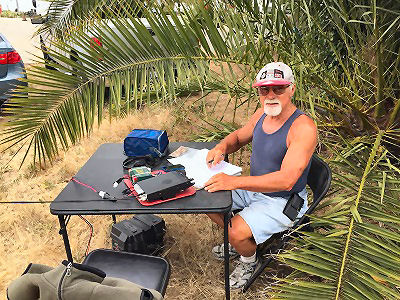
Profile Photo: Taken during Field Day 2015 of me and my portable rig.
My Interests
HF CW: QRP/QRO/QRS/QRQ/QSK/QTX; Traffic nets; Sprints; Rag chewing; SOTA Activations.
FRN: Members of the North American QRP CW Club are welcome to join several of us in the Western States for either of two FarnsWORD roundtable "social" nets ("CQ FRN") Sunday evenings at 5pm PST on 7065 kHz and again at 7pm on 3556 kHz. We're working on our "head copying" skills by sending at 21 wpm while adding extra space between words, if necessary, for slower operators.
My CW Hangouts: I monitor or call CQ most mornings around 6:30-8:00 am PT on 80 thru 20 meters on the FISTS calling frequencies (3558, 7058, 10118, 14058 kHz) looking for a CW rag chew. I'll happily QSO from 10 to 30 wpm, straight key or keyer.
CW Motto: Always properly space letters and words. O6ER WI SEU H3O DE COD ESOG 6ING LIC 6IS.
PSK31 and other digital modes: I just got digital modes up and running, as of Nov. 29. PSK31 is about the right speed for my typing skills. While I might use a few macros, I really enjoy keyboard-to-keyboard QSOs on 80, 40, and 20 meters (so far). I also enjoy experimenting with some of the MFSK modes, like Olivia 500/8, DominoEX8, and just plain MFSK16.
VHF/UHF: Bicycle mobile; FM simplex. I ride to and along the beaches about 3 times a week (100 miles/week), often listening and talking on various 2m and 70cm repeaters and simplex channels.
General: Arduino; Raspberry pi; Antenna experimentation; Solar power; Portable operation.
My Ham Affiliations
American Radio Relay League;
CW Operators (CWops # 1466);
Straight Key Century Club (SKCC # 13569);
Fists CW Club (FISTS # 17247);
North American QRP CW Club (NAQCC # 7686);
QRP Amateur Radio Club International (QRP ARCI # 15691);
4-State QRP Group (4SQRP # 957);
Flying Pigs QRP Club (FPqrp # 3584);
Quarter Century Wireless Association (QCWA # 36912)
Westside Amateur Radio Club (WA6RC.org)
My Equipment
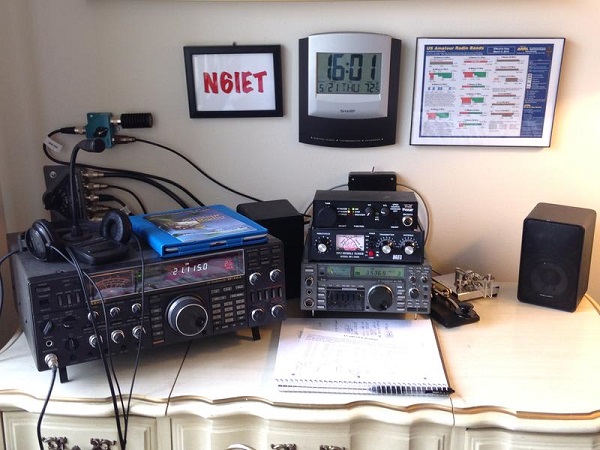
HF Rig: Icom IC-761 and IC-735;Ten-Tec Patriot 507 Arduino-based QRP rig (40 & 20 meters).
I now also have a SignaLink (not shown) for the digital modes.
VHF/UHF Rigs: Yaesu FT-60 dual band HT and Kenwood TH-79a dual band HT, each w/bicycle "hands-free" setup.
I mounted the Diamond NR770HMNOB dual band vertical mounted on the rear bike carrier.
VHF/UHF Antennas: Cubex "Yellow Jacket" dual band quad; Alinco DJ-G7T tri-band radio; Comet GP-95 tri-band base vertical.
Portable All-Band/All-Mode "Breadboard Rig": Yaesu FT-857D mounted on breadboard with 4 Amp-hour LiFePO4 motorcycle battery and American Morse straight key and paddle. I use this rig on my balcony as well as for Field Day and overnight camping excursions. The Breadboard Rig weighs a total of 10 lbs.
Portable QRP "Clipboard Rig": Ten-Tec Patriot mounted on a composite clipboard with 2 Amp-hour LiFePO4 motorcycle battery and old Radio Shack straight key. I left room for a single-lever American Morse mini-paddle (ordered). I use this rig for QRP sprints on my balcony and plan to take it up to summits for SOTA activations when weight is an issue. The Clipboard Rig weighs a total of 4.5 lbs.
Unfortunately, I accidentally brushed one end of the keyer cable across the positive battery post (while the other end was plugged into the Patriot) and killed the keying circuitry. Maybe I'll eventually figure out how to fix it.
Portable HF Antenna: 20/40 meter fan dipole (also works on 15 meters) atop 35-ft telescoping aluminum mast. The antenna and mast weigh 12.5 lbs. Note that I use hose clamps as simple stops near the bottom of each section and so don't need to cut slits into the tops of each tube to secure them. This is the antenna I used for Field Day 2015 and for my first SOTA activation of San Gabriel Peak.
Solar Power: I have added solar power to my balcony station. My FT-857D is powered by an 80 Amp-hour deep cycle (marine) battery that is kept charged by a new 45-watt solar panel kit I purchased from Harbor Freight for about $150 (including the charge controller). It works great! I can work QRO (100 watts) for several hours a day and/or evening, and the battery will be fully charged again by noon the next (sunny) day.
My Ham Bio
I got my Extra reinstated with a newly issued call (AI6FR) on Nov. 21, 2014, after being off the air since 1993 and letting my former license (N9EX) expire in 1997. I got my current vanity call (N6IET) on Mar. 14. I now go by the handle Rick on the air. Details below:
KN5FMF - I grew up in Carlsbad, NM, and got interested in ham radio at age 14. I remembered that my former Cub Scout den mother's husband had some kind of a radio shack behind their house. He was Lee Almy, W5WBD. He had a 10/15 meter cubical quad w/"armstrong" rotor next to his shack. He used a National HRO-50 receiver with a Heathkit DX-100 "plate modulated" transmitter. He lent me an Instructograph Morse code practice machine (w/vacuum tube oscillator and spring-wound punched tape mechanism) to send practice 5-letter code cyphers. I had learned Morse code for a Boy Scout merit badge. It took me two weeks to get my code speed to 7 wpm and pass the Novice exam.
I got my ticket in the mail about 6 weeks later (after my 15th birthday in August, 1960). My first station was a Philmore general coverage receiver kit and a used Heathkit AT-1 CW transmitter (about 20 watts output) into to an end fed longwire antenna (no tuner) routed under the eves of our roof. My first contact on 7153 kHz was with Fred, KN5EIE in El Paso. Everything I touched in the shack gave me RF burns. :-)
K5FMF - With the help of another Elmer, Dick Bikkers, K5EHB, I earned my Conditional ticket a month later (issued in September). I built a Heathkit DX-60 and used it with a Navy surplus regenerative receiver, mostly on 40 meter CW. I also checked into a 40 meter phone net regularly called "The New Mexico Breakfast Club". (A bunch of old fogies. Now I'm an old fogy!)
About a year later I built a Heathkit HG-10 VFO and a Knight-kit R-100 receiver. Here's what I and my station looked like.
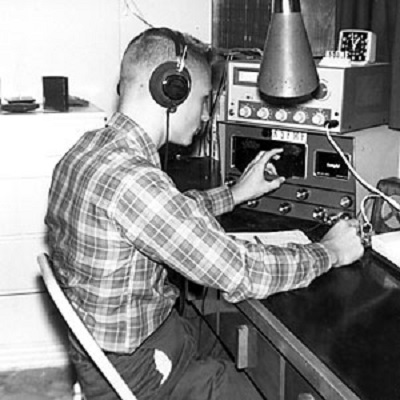
Around 1962 I built a QRP 1-watt CW transmitter for 40 meters (w/2N696 finals) and a matching receiver using a 7-transister AM pocket radio as the IF. Ultimately, I worked 30 states with that rig on 7053 kHz.
WA4NEM - My family moved to Lakeland, FL, in 1963 - during the middle of my senior year of high school. I put up a 40-meter inverted vee on a 40-foot telescoping ("push-up") mast. I built an Eico 753 tri-band (80-20m) transceiver kit (with a solid state VFO and a pair of 6148 tube finals). I called it the "seven drifty three", because its VFO drifted badly.
I started majoring in EE at NMSU, where I operated the club station, W5GB, occasionally, for the next 12 months.
I transferred to Polk Junior College (in Bartow, Fla, at the time) for a couple years, operating from home. My 40-foot pole got struck by lightning. That melted my RG-58/U feedline and toasted the rectifier diodes in my Seven Drifty Three. (The antenna was unplugged; the damage came via a six-inch spark from my antenna disconnected feedline to my Heathkit keyer cable and then through the transceiver to ground thru the power outlet.)
In 1965 I drove to Tampa and took and passed the Extra Class exam. I had trouble sending 20 wpm with a straight key, but receiving at that speed was no problem. I seem to remember having to actually draw a schematic of a Colpitts Oscillator. I also took and passed my Radiotelephone Second Class License exam while I was at it. Later, I passed the First Class exam.
In 1967 I started my junior year as a Psychology major at UF in Gainesville. When I came home on weekends I continued to operate HF with my Eico 753 along with 6 meter AM using a Heathkit "Sixer" I'd bought used.
In early 1970 I quit grad school (at UF) and joined a commune called Twin Oaks in central Virginia. I never got on the air, there; I must have sold my ham gear. What was I thinking? Ham radio from a rural commune would have been a great idea!
In early 1971 I left the commune and joined the residential staff of Green Valley School (for emotionally disturbed adolescents) in Orange City, Fla., and helped 6 teenage boys earn their Novice tickets. We used my homebrew QRP rig and a 40-meter dipole as our station.
WA3SQQ - About 9 months later I moved to Silver Spring, MD, to live with with my brother and some other people. I didn't get back on the air until I got a teaching job near Croom, MD (25 miles SE of DC) in 1972. There I rented the basement apartment of an old farmhouse and erected a Hustler 4BTV vertical (with 8 buried ground radials) and built a Heathkit HW-101 transceiver. I had fun running the MDD CW traffic net on 40 meters (again), mostly.
W3HMT - The FCC changed the rules and allowed current holders of 1 x 3 calls to get another 1 x 3 call in their new call district. So I applied for a secondary station license based in my NM home town and got my former K5FMF call back. Then I finessed the 1 x 3 station license to get W3HMT in exchange for WA3SQQ.
In 1973 I talked the landlady into letting me put the vertical on the chimney of her all-metal roof. That worked OK, but the bandwidth was a bit narrow on 40 meters.
W9NJG - In April, 1974, I secured a technician job with Motorola in Schaumburg, IL, while visiting my parents in Lincolnshire (near Deerfield) and moved back in with them for a year. I built my own gin pole from a heavy aluminum conduit and erected a 55-foot Universal steel tower bracketed to their roof just outside my 2nd-story bedroom. I put a Moseley TA-33 triband beam on top, and strung 40 and 80 meter inverted-vees just underneath. No guywires were needed. It was a great setup. I had the power company fix half a dozen sources of powerline noise I had sniffed out in the neighborhood in those days using a portable SW radio.
A year later (1975) I bought my first home, a cheap old one-bedroom cottage near Lake Zurich. I moved the tower and added sections to take it up to 70 feet, guyed at three levels. I put egg insulators on the top set of guys, making them into 40-meter reflectors for three 40-meter sloper dipoles in between the guy wires. I was almost always able to get a 6dB advantage of one sloper over the others during a contact, so they worked. I also put up an 80-meter inverted vee, which just fit corner-to-corner on my 120 x 135-foot lot. My hamshack was a small furnace room at the rear of the house right next to the base of my tower. I built a nice custom desk/table for it from plywood and 2 x 4s.
About that time I met some hams that hung out on a 2-meter repeater (147.72/12) in Crystal Lake. I built two 8-element quagis (quad driven- and reflector elements with 6 yagi director elements on wooden booms) and mounted them about 10 feet apart, vertically polarized, and installed it ten feet above my tribander. (I can't remember how I harnessed the two antennas into a single feedline.) Boy was the main lobe sharp!! I could work mobiles simplex for a radius of at least 50 miles!
I also got into 2-meter fox hunting. I built a cubical quad using wooden dowels and stiff aluminum clothesline wire, and the antenna had no tendency to windmill when driving 60 mph. I could unscrew one wing nut to detach the boom from the mast when we reached the point of having to proceed on foot and used it with a home-made voltage controlled audio oscillator whose pitch was controlled by the voltage output of a diode detector. It worked like a charm just aim for the highest pitch!
N9EX - In about 1977 the FCC allowed Extras to get a 1 x 2 call of their choosing. The 'N' prefix had just been made available. I considered what might sound short and rhythmic on CW and not require phonetics on phone; I picked N9EX and got it!
In addition to my HW-101 transceiver I bought a used Drake R-4C receiver (for QSK CW) and built a Heathkit SB-200 amp. I had a great setup!
I also bought an Icom IC-2AT and operated bicycle mobile with a quarter-wave ground plane mounted behind and above my head on the rear bike carrier. I built a Heathkit HW-8 QRP rig. One Field Day I took it with me on my bike 50 miles away to Big Foot Beach State Park near Lake Geneva, Wisc. I strung up a 40-meter dipole in a tree. I rode 50 miles each way to that campsite.
In June of 1982 I wrote code to implement a matching/dating service on my Apple II, called ComQuest, and simultaneously met a guy who became my domestic partner for 21 years.
In 1987 my partner talked me into buying a larger house in Palatine, IL. I hated having to move that dang tower! But the new house was on a one-acre lot. I erected the tower next to my bedroom at the dead center of the lot, which gave me room for a full half-wave 160 meter inverted vee dipole. I fed that with 450-ohm ladder line through an antenna tuner. I sold the tribander and put up a Moseley Pro-57, which covered the new WARC bands. Three ham buddies helped me erect all 80 lbs of it on top of that tower, above which I stuck a 5/8 wave 2 meter vertical/lightning rod. No more 40-meter slopers or quagis (whose wooden booms had warped badly).
In about 1990 I purchased a barely used Icom IC-761 transceiver from a ham friend. What a beautiful rig, with full-break-in CW! I had the perfect station! That same friend sold me a Heathkit SB-220 linear. I sold the Drake R-4C and the SB-200.
In 1992 my partner moved to LA to earn his PhD at UCLA. I got into packet radio about that time and set up my own packet BBS on 220. Lightning struck my tower and blew up a DOS laptop I was using for packet and AMTOR. (The laptop wasn't plugged into anything, but my desk was only a few feet from the base of the tower, and the EMF damaged it, I guess.) I don't remember having to replace the 2-meter vertical or any of the feedlines.
In 1993 I shut down ComQuest and moved to LA to rejoin my partner, who was attending UCLA. I packed all my radio gear and put it into storage (along with most of our furniture), and we moved into an apartment with our two cats. The newly emerging Internet occupied my attention, and I never got on the air again during the next 21 years. My license expired in 1997, and somebody else eventually got my perfect call sign! :-(
We moved to Atlanta in late 1996, and I started working for the IT department of a large hotel chain. Then I opened my own personal training studio in 2001, RealExercise, LLC.
After my mother died in 2004, I shut down my not-very-successful personal training business and purchased and moved into her beautiful lakeside home on a 1.2-acre lot in Oconee County, SC in 2004. I decided to retire at age 59. I considered getting back into ham radio, but I knew I'd be fighting the local association to put up a tower. I enjoyed bicycling and kayaking on Lake Keowee, in the meantime.
In 2008 I realized I couldn't afford to keep the house AND retire, so I sold the house and moved back to LA into an apartment in Westwood (near UCLA) again. I've enjoyed playing the piano and trumpet for pleasure. I ride my bicycle to and along the beaches about 100 miles per week. I work out weekly at a gym. My cat Tawny is my domestic partner. But by late 2014 I started getting the itch to get back on the air.
AI6FR - So in November, 2014, I took and passed Element 3 for the Technician license and was grandfathered back to Extra Class. I got my new ticket on Nov. 21!
My apartment building is on top of a ridge and my top floor balcony overlooks the UCLA campus, with Mt. Lukens, Mt. Disappointment, San Gabriel Peak, Mt. Wilson, and Mt. Baldy/San Antonio as a scenic backdrop.
Hoping my landlord would let me put some kind of vertical on the roof, I got my old equipment out of storage but was afraid to plug it in out of fear that the electrolytic caps would pop like firecrackers after 21 years of being mothballed. I discovered that, in addition to the IC-761, I still had an Icom IC-735 portable transceiver that I had purchased barely used from that same ham friend in 1993.
Both rigs have now passed the smoke test, but the IC-761 didn't work reliably on the lower HF bands. The rest of my ham equipment mysteriously disappeared during all the moves and storage.
In the meantime my current landlord said YES to the antenna, and I purchased and installed a Hy-Gain AV-640 multi-band vertical on the roof of my apartment building.
While I was waiting for the backordered AV-640 I purchased a dual band quad from Cubex and assembled and mounted it to the edge of the roof that overhangs my balcony wall. I turn it by hand.
I bought a used Realistic HTX-404 handheld from a friend and listened for a week trying to decide if there's anybody I'd like to hang out with on 440 MHz. I finally decided to join the PAPA System, which consists of 13 linked analog repeaters (and several linked D-STAR and DMR repeaters) covering most of Southern California. I've also joined the Westside ARC here in West LA. The quad comes in handy when I want to work simplex or get into a distant repeater.
N6SEX - I got this vanity call on Feb. 3, 2015. I chose this call because it met all three of my criteria for a good call: (1) It's easy to understand on voice without phonetics; (2) it sounds rhythmic and short on CW; and (3) it's easy to remember. A 4th advantage is that it ends with the same two letters as my former 1 x 2 call, N9EX, which I had chosen for similar reasons back in 1977 when I lived in Illinois.
On that same day I installed a modification to my AV-640 HF multi-band vertical to add 80-meter coverage to it. Hy-Gain agreed to send me a new matching unit, resonator section, and 80-meter top hat radials for the difference in price between the AV-640 and the AV-680. They had never tried this before and don't offer this as an upgrade.
The modification was successful, and now I have the equivalent of an AV-680 on the roof of my apartment building. My 3:1 SWR bandwidth was reduced from 235 kHz to 165 kHz on 40 meters. The bandwidth on 80 meters is only 65 kHz (not the 75 kHz advertised), but that's fine. It covers the NTS and FRN CW nets I'm now active in.
I purchased an MFJ-945E antenna tuner to use with the AV-680 and my IC-735. After fixing 7 intermittant shorts (all in the open air coil taps) it works great. My IC-761 has a built-in ATU that also works great!
N6IET - On Pi Day, 2015, I received yet another vanity call sign, N6IET. N6SEX was too controversial and caused certain people (including myself) a bit of embarrassment in certain situations. Other than that it was the perfect call for me. I really hated giving it up.
I can now operate HF from my balcony (with a battery) using a 40-foot LMR-240 feed line extension to my HF vertical connected to that large antenna switch you see behind my IC-761. The extension goes through two walls at the baseboard to get from my bedroom through my kitchen and living room to the balcony. (Don't tell my land lady!) I use the Ten-Tec Patriot out there for QRP sprints, sometimes. More often I use my new FT-857D "breadboard rig" out there.
I didn't get the last two 1 x 2 vanity calls I applied for, N6EU and K6SS. It's like a lottery here in the 6th region! So I've decided to stick with the 1 x 3 I now have.
Current Events
WA6RC Field Day 2015
I tested my portable "breadboard" station during my local club's Field Day on July 25, 2015. Both the rig and fan dipole supported by the telescoping aluminum mast worked splendidly.
San Gabriel Peak Summit Activation 2015
On Sunday, July 19, I "activated" San Gabriel Peak for SOTA chasers. I drove about 45 miles to a parking area most of the way up the San Gabriel mountains between Mt. Wilson and Mt. Disappointment, from which I hiked along a fire road for about a mile and then up a steep trail for another mile up to San Gabriel Peak, which is designated on SOTAWatch.com as W6/CT-019. The vertical rise above the parking area was about 1000 feet, with the peak listed as 6161 feet above sea level. I can see this peak on any clear day from my balcony. It's the highest peak visible in the background.
Below is a photo taken by a passerby of me toward the beginning of my hike with San Gabriel Peak in the background. It might not look like it but it was a grueling 1.7 mile, 1000 ft ascent to the top from there.
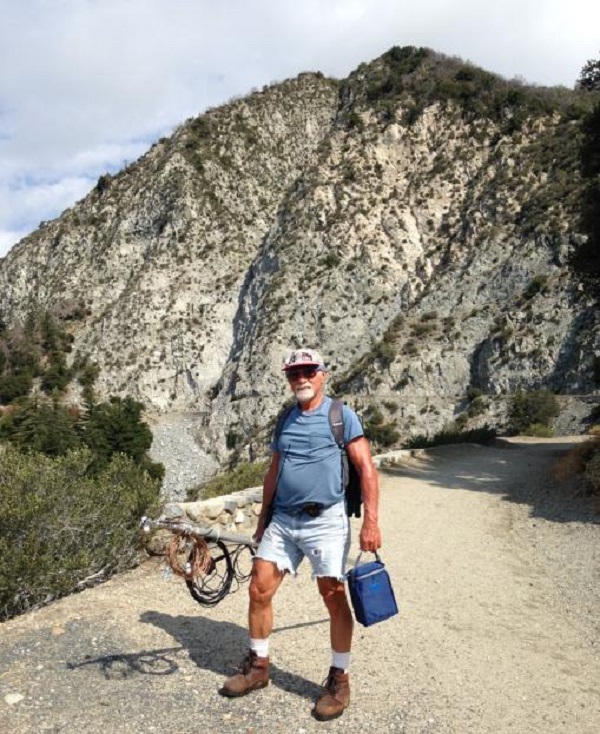
In addition, my "breadboard rig" was tucked neatly into my backpack with room to spare, with my Coleman folding seat riding over the outside of the backpack, weighing a total of about 12 lbs. The cooler bag contains two Atkins shakes along with some of those freezer paks to keep then cold. So my total load, in addition to my body weight of 162 lbs, added up to about 25 lbs. Most SOTA activators would be shocked - SHOCKED - at the weight of my rig and antenna, not to mention the fact that I didn't take any water up with me. (I drank lots of water at the car and figured it would hold me for the duration until I got back to the car, thus saving two or three pounds of load. Big mistake!!)
That's my summit setup shown below. The bench was a heavy length of iron, perfect for my VHF/UHF mag mount!
The SOTA activation was a great success, and a great learning experience. I know a few things not to do or to do differently. I'm resistant to taking other people's advise, once I have a plan. Live and learn! First, let me offer my justification for carrying such a heavy rig:
I wanted a good signal from the summit and decided to buy the full-powered (100W) Yaesu FT-857 instead of the QRP (5W) FT-817, the most popular SOTA rig of all time. (The Elecraft KX3 is even more popular among those who can afford one; it's the Cadillac or Collins of portable transceivers.) My "breadboard rig" also makes a great rig for a radio camp, for Field Day, and to use with solar power on my balcony.
I also have a much lighter Ten-Tec Patriot (5 watts on 20 and 40 meters) that I could have taken, instead, and with the great antenna, 5 watts might have been enough for most of the stations I worked to have heard me. A QRO rig requires a bigger battery, and the LiFePO4 motorcycle battery weighs only 1.5 lbs and is rated at 4 Amp-hours. However, the FT-857 does not have a built-in automatic antenna tuner (and neither does the Patriot), which influenced my antenna choice. Having to use an external tuner with some kind of end-fed or shortened antenna adds weight and complications and isn't as good at radiating a signal.
I had used fan dipoles back in the 60s when I was a teenager. They work great! Feed full half-wave dipoles on two or three different bands, all attached at the same center insulator and fed with a single coax feedline (no balun needed), and you have all the advantages of full-sized separate dipoles but with a single feedline: broad bandwidth (no need for baluns or tuners), high efficiency, and (mostly) horizontal polarization. But for 20 meters and above, you need to get the center of the inverted-vee dipole up to about half a wavelength, which is 33 feet on 20 meters. That's just a little bit more than most fiberglass fishing poles and kite poles can go and still support the weight of the wires and feed line without buckling. So I found where to buy telescoping 6-foot sections of aluminum tubing - Texas Towers - and got me some. I ended up ordering 8 sections, going from 3/4 inches to 1-5/8 inches in 1/8-inch increments. I've never used the largest section, which I don't really need.
When extending the sections and overlapping each section 12 inches, seven sections can achieve a height of 36 feet. But I ended up only extending the pole to 30 feet, for various reasons. Next time I'll take only the top six sections but overlap them only 6 inches, for a maximum height of 33.5 feet - perfect! That will save at least a pound of weight. I'll use seven - or maybe all eight - sections on longer camping trips and future Field Days. Or I could just use the top 5 sections for a center height of 28 feet, saving even more weight.
I could reduce the weight by another pound by substituting thinner, lighter antenna wire and using coat buttons instead of those heavy ceramic end insulators. (You don't really need insulators per se when using synthetic cord to tie each end of the wire to a tree or bush.) But all-in-all, I'm in love with this setup, and I'm not interested in switching to a 3-ounce end-fed wire with 9:1 balun and 5-lb fishing pole or some kind of loop or coil-loaded vertical.
Guying the bottom section of mast using poly cord and thin steel tent stakes was a good idea, but I needed a better way to store the wires and poly extension cords without having to worry about premeasuring them or cutting each one to length. It took a good 30 minutes to erect the antenna and another 30 minutes to take it down and coil everything neatly, but I think I can cut that down to 10 minutes each.
Long story short (oops, too late) I ran 20 watts and worked 16 CW stations on 20m and 8 on 40m, as well as another dozen on 2 meter FM, all within about an hour of operation, at the end of which my LiFePO4 motorcycle battery was only half depleted. I could have gone another hour, but I ran out of SOTA chasers to work. I'll be doing this again!
Santa Cruz Island PAPA "Radio Camp" 2015
On August 6, 2015, I boarded a boat in Ventura Harbor with several other PAPA members, and we sailed 20 miles across the channel to Santa Cruz Island for a 4-day "radio camp". The island has no AC power or cellphone coverage. And no stores for purchasing forgotten supplies.
In preparation I built another version of a fan dipole using lamp cord. I remembered reading an article decades ago about a multi-band dipole made from a single length of 4-conductor flat rotor control cable, with each conductor cut for a different band. The conductors were not separated and must have been about 1/16 of an inch apart. So I figured I could use "zip line" (fancy word for lamp cord) to combine two bands on each of two dipoles at right angles to each other, thus doubling the number of bands without requiring additional end supports. I decided to combine 40 and 20 meters in one direction and 30 and 17 meters in the other (at right angles).
Long story short, it didn't work at all during my rooftop testing. I got no SWR dip at either 20 or 17 meters. So then I pulled the two conductors apart all the way back to the center insulator and tied the ends of the shorter conductors to the end insulators of the longer conductors (using twine), and made sure that one conductor sagged a few inches below the other all the way from center to end. And, guess what? It worked like a charm! I got dips (using my antenna analyzer) on all four bands, plus dips at the top ends of 15 and 10 meters, as well (where the 40 and 30 meter wires acted as 3/2-wave dipoles). So this little fan dipole covers 4 CW bands and 2 phone bands without any need for a tuner - and with an SWR less than 1.2:1 at resonance in the 40, 30, 20, and 17 meter CW bands, once I had adjusted the lengths.
I zipped the entire antenna and telescoping aluminum mast (and a folding chair and some other stuff) into my old sleeping bag which I then enclosed in a surfboard case (totalling about 30 lbs), which the ferry would allow on the boat as luggage. Plus I had my 50-lb ice chest (with two giant slabs of dry ice) and my 40-lb duffel bag and my 15-lb backpack holding what I now refer to as my "Breadboard rig" (FT-857 with LiFePO4 battery and keys and mic) and my brand new and untested 4-panel folding solar collector and charge controller, and my logbook. Naturally, I had to carry all that stuff from the dock onto the boat and again from the boat to the anchorage at the island. Fortunately, others in our party had smuggled two-wheel "deer carts" onto the boat to help transport our stuff (in several trips) from the anchorage to the campsite half a mile away.
The antenna went up nicely, but one end of the 30/17 meter dipole had to go through some tree branches, bending around them quite a bit. But the insulated wires seemed unaffected by contact with leaves and branches, and the antenna loaded perfectly on all bands. The mast was the same seven 6-foot sections of telescoping aluminum tubing that I had used on my San Gabriel Peak SOTA activation and during Field day. I extended it to its full 38 feet height. The soil was so rocky that I could only drive one of the three tent stakes into the ground for the lower guy ropes. Do you like my workaround for the other two?
Long story short (well, I guess it's too late for that), I had a great time on the island camping for the first time in about 30 years. I did lots of hiking and sea kayaking/cave exploring, but very little operating. The background noise was so low that it didn't even register on my S-meter, compared with an average S-7 noise level at home using my rooftop vertical. But conditions were not very good that weekend, and signals were few and weak on all bands. I got on for less than an hour each day, Thursday, Friday, and Saturday evenings (around sunset) and Saturday morning (around sunrise), but I only worked a total of 8 stations, 3 or which were working the SKCC weekend "cootie" sprint.
73 de Rick, N6IET
December 23, 2015