 |
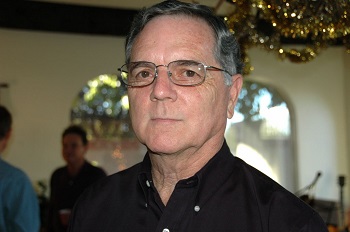
N7WS Wesley D. 'Wes' Stewart Tucson, AZ QCWA # 22806 Chapter 16 |
I began short-wave listening here in Tucson, Arizona in the early 1950s after my dad brought home a WWII surplus BC342-N receiver (I still have it). I discovered the ham bands quite by accident and decided to learn more about what I was hearing. After some self study, I passed my Novice exam in 1958 and upgraded to Conditional the same year. (My "Elmer" was W7UVR (SK). I upgraded to Advanced Class in April 1977 and passed my Amateur Extra Class in October of that year,
Currently, my main interest is working DX. I am on the DXCC Honor Roll with stats of: 349 Total, 337 Current, 8BDXCC, DXCC on Phone, CW and RTTY and ~ 1600 for DXCC Challenge. I have the Worked All Continents award on 2-meters. Non-DX awards include WAS Triple Play, over 28,000 points in the ARRL Centenial Points Challenge and W1AW WAS. All of these contacts have been made with modest stations located within 10 miles of the center of Tucson.
I am a charter member, past President and immediate past Vice President of the Southern Arizona DX Association (SADXA), a member of the Central Arizona DX Association (CADXA), the Northern California DX Foundation (NCDXF), the ARRL and I support Clublog.
Previous interests include homebrewing equipment and weak-signal 2-meter work. I was a very early adopter of VHF CW-SSB and worked meteor and troposcatter, as well as two-meter EME (pre-digital) After a long absence from ham radio and a station relocation I abandoned those pursuits.
N7WS is now located on two acres of beautiful Sonoran Desert, a few hundred meters from the western unit of Saguaro National Park on the western side of the Tucson Mountain range, at an elevation of approximately 2,500' (800m) ASL. The opening photo shows my antenna with a Saguaro cactus (Carnegiea gigantea) in the foreground. The blossem of the Saguaro is the state flower of Arizona.
Although I have room for more, my antennas have always been modest. Previously, I used a home-designed and built three-element Yagi for 20-meters at 15 meters above ground (seen in the photo below) and an inverted-vee dipole for other bands. Now, against my own belief that hams should always build their own antennas---after a deal I couldn't pass up---an Optibeam OB7-3 triband Yagi has replaced the 20-meter monoband Yagi.
I enjoy experimenting with antennas both in the field and on the computer. The photo above shows my tower-mounted antenna system and a vertical antenna under test in the field. My "field antenna lab" equipment consists of N2PK and DG8SAQ (SDR-Kits) Vector Network Analyzers. The photo also shows that the Sonoran Desert is anything but sand. Everything in the photo can stick or scratch you however.
For antenna modeling, I use the wonderful software, EZNEC+, from W7EL and AutoEZ, by AC6LA.
Inside my "shack" my station equipment is an Elecraft K3 or K3S driving an Elecraft KPA500 and KAT500 tuner. I also use an SDR-IQ SDR from RF Space with SpectraVue software as a panadapter (bandscope) on the I-F output of the K3.
Professionally, I was employed at Hughes Aircraft Company, Missile Systems Division, for 30 years. During that time I held a number of positions and worked on many tactical missile programs, primarily in the field of RF/uW design and evaluation. I took early retirement from Hughes as a Member of the Technical Staff in 1996. Following the acquisition of Hughes by Raytheon I worked there, primarily on the Tomahawk and Standard Missile programs, until my second retirement in 1999.
I QSL 100% for cards received (including SWL) with SASE. DX and DX SWL received by the bureau are answered 100% via the bureau. With rare exceptions, stateside cards received without SASE are not answered. If I owe you a card and you haven't yet received one, send me an email and I will get one to you.) You can see if you are in my log with the ClubLog tool below. I upload my log regularly to LotW and prefer that method.
September 13, 2016